

AI Tools for Blind and Low Vision Users: OrCam, Meta Glasses, Envision, WeWalk, and Glide
November 20, 2026
Cameras and artificial intelligence now power a growing set of tools for people who are blind or have low vision. Some read and describe, some add sensors to a familiar cane, and some physically guide your steps. This page covers five of them: OrCam MyEye, Meta's AI glasses, Envision Glasses, the WeWalk Smart Cane 2, and Glide. Each is strong at a different job, and many people use more than one. Human remote visual interpreting services such as Aira and Be My Eyes are a different category, built around a trained person or volunteer rather than AI, so they are not covered here.
What Does OrCam MyEye Do for Blind and Low Vision People?
OrCam makes AI reading and recognition devices. The OrCam MyEye 3 Pro is a small camera that attaches magnetically to your glasses. It reads text aloud, recognizes faces, and identifies products, money notes, and clothing colors. You control it with voice commands, hand gestures, or a touch bar, and OrCam says no connectivity is required.
OrCam is a strong fit when reading is the main job. A menu, a medication box, or the day's mail can be read hands-free without calling anyone. OrCam's handheld Read 5 and Read 3 suit people with low vision or reading fatigue who mainly want help with print. See the OrCam MyEye 3 Pro page for details.
Are Meta AI Glasses Useful for Blind People?
Meta's AI glasses are mainstream eyewear with a camera, open-ear speakers, and Meta AI built in. The range includes Ray-Ban Meta (Gen 2), Oakley Meta HSTN, Oakley Meta Vanguard, and Meta Ray-Ban Display. They look like ordinary glasses and cost far less than most dedicated assistive devices. Meta's page for blind and low vision users lists the features that matter most here:
- Meta AI can describe your surroundings, read text, and identify objects when you ask.
- Detailed Responses, turned on in the Meta AI app, gives richer descriptions of objects, colors, and surroundings.
- Live AI lets you hold a continuing conversation with Meta AI about what the camera sees, without repeating "Hey Meta."
- Saying "Hey Meta, Be My Eyes" connects you hands-free with a sighted volunteer in supported markets.
Meta glasses are a great choice for describing a scene or image, getting quick questions, and hands-free calls and messages on WhatsApp and Messenger.
What Do Envision Glasses and Ally Solos Glasses Do?
Envision builds AI tools specifically for blind and low vision users. Envision Glasses bring its software to smartglasses, with real-time text recognition, voice controls, and hands-free video calls to a trusted friend or family member. The Read Edition focuses on reading, with Instant Text, Scan Text, and Batch Scan for multi-page documents. Home and Professional add Describe Scene, Recognise Cash, and Find People.
Envision also developed Ally Solos Glasses with the eyewear company Solos. They run Ally, Envision's accessibility-first AI assistant, which reads text, describes surroundings, and recognizes faces and objects. Envision lists them at under 50 grams with a powerful 15-hour battery.
Envision is a strong fit for people who want tools designed around blind users from the start, especially for reading longer documents. Check the Envision shop for current availability, since every edition showed as sold out at the time of writing.
What Is the WeWalk Smart Cane?
The WeWalk Smart Cane 2 is a primary mobility aid in the cane category: a white cane with added sensors and AI. WeWalk says it detects obstacles up to chest height, the kind a cane tip sweeping the ground can miss, and alerts you. It also has a built-in voice assistant and turn-by-turn voice navigation through the WeWalk app, controlled from the cane. When it is not connected, it still works as a lightweight traditional cane for ground detection.
WeWalk is a great fit for experienced cane users who want extra warning about objects above the ground and directions built into a tool they already know. WeWalk offers a 30-day risk-free trial.
People often call Glide a smart cane, but it works quite differently from a cane. A smart cane like WeWalk adds sensors to the cane you sweep and alerts you to what it finds, whereas Glide is physically steering and braking for you.
What Does Glide Do?
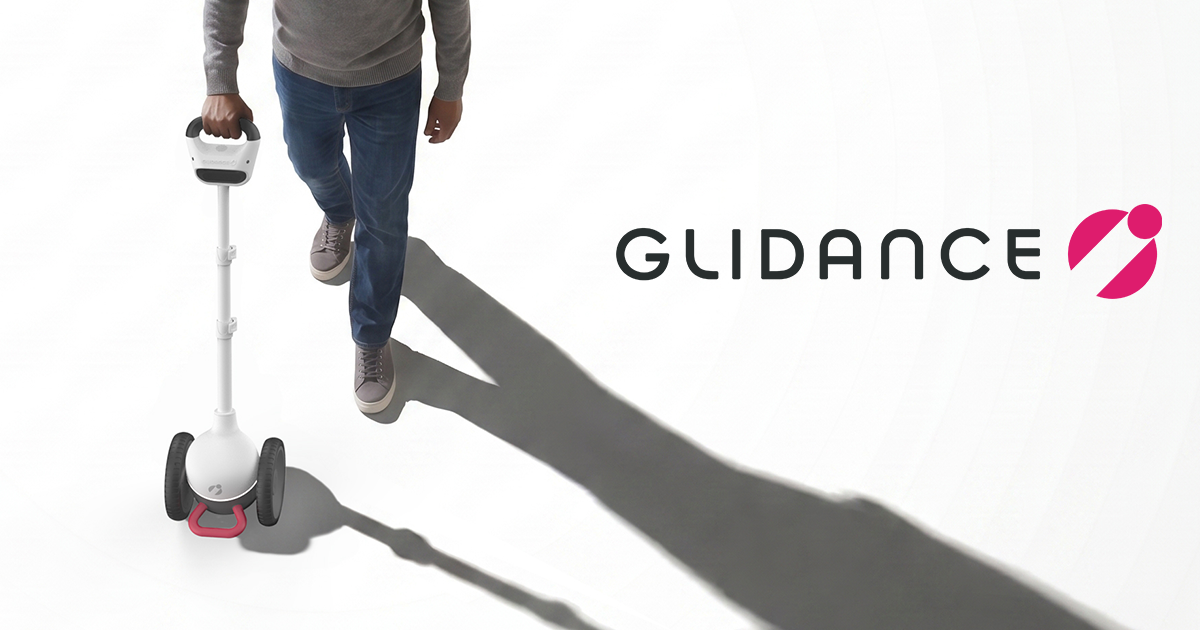
Glide is a primary mobility aid for people who are blind or have low vision, offered as a third option alongside the white cane and guide dog. You hold an adjustable handle and walk at your own pace while Glide rolls ahead on two wheels and steers and brakes for you. Stereo depth cameras in the handle detect ground and overhead obstacles and drop-offs. When a path is fully blocked, Glide brakes and tells you. It runs on Glidance's Agentic Wayfinding™ technology, which is designed to navigate without HD maps or prior knowledge of the environment.
At a crosswalk, Glide announces the approaching road and stops before the curb. Glide does not read traffic signals, so you decide when to cross, and it then keeps you walking straight.
With the Glide Agent, you can also ask Glide to describe a scene, and it will tell you what it sees. You can then ask it to guide you to anything within its camera’s line of sight.
Glide has limits. The current device is not weight-bearing, so it does not currently work with walkers, rollators, support canes, or wheelchairs, and it is recommended for ages 13 and up. It needs a smartphone, and it does not replace orientation and mobility (O&M) training. Casey Mathews, a Founding Glider in the pilot rollout, wrote about using Glide and his cane: "The two aren't really competing for the same work."
How OrCam, Meta Glasses, Envision, WeWalk, and Glide Work Together
These tools overlap less than the shared AI label suggests.
Picture a trip to the pharmacy. Glide steers you along the sidewalk and around a sandwich board outside the door, or a WeWalk user gets an alert about a low-hanging sign. Inside, you ask your Meta glasses to describe the aisle. At the shelf, OrCam or Envision reads the small print on a medication box.
What Do These AI Tools Cost?
- OrCam: OrCam's US site lists no prices. US retailer MaxiAids lists the MyEye Pro at $4,250, so confirm current pricing with OrCam or an authorized dealer. OrCam offers a 30-day refund and a 2-year warranty.
- Meta AI glasses: Meta lists its AI glasses from $224 and Ray-Ban Meta (Gen 2) from $379. Prices vary by style and lenses.
- Envision: The Envision shop lists Envision Glasses at $1,899 (Read), $2,499 (Home), and $3,499 (Professional), and Ally Solos Glasses at $699. All showed as sold out at the time of writing.
- WeWalk: WeWalk advertises payments starting from $70 with up to 12 months of installments and says the cane is HSA/FSA eligible. US retailer MaxiAids lists the Smart Cane 2 at $850.
- Glide: Preorder units sold out at the $1,499 preorder price, and final retail pricing has not been announced yet. You can join the waitlist for when orders reopen.
On coverage, the Glidance FAQ says Glide is not currently reimbursable by US insurance. For any of these tools, ask a vocational rehabilitation (VR) counselor or your employer about funding or workplace accommodations.
Frequently Asked Questions
How does OrCam MyEye work and who is it best for?
OrCam MyEye is a small camera that attaches magnetically to your glasses. A voice command, hand gesture, or touch bar triggers it, and it reads text aloud, recognizes faces, and identifies products, money notes, and colors, with no connectivity required. It is best for people who want hands-free reading and recognition during the day. The 30-day refund window gives you time to test it.
Are Meta Ray-Ban glasses good for blind people?
Many blind and low vision people find them very useful. Meta AI can describe surroundings, read text, and identify objects, and Detailed Responses adds richer descriptions. You can also call a Be My Eyes volunteer hands-free. Starting at a few hundred dollars, they are among the most affordable AI glasses.
What do Envision Glasses do?
Envision Glasses are smartglasses running Envision's software for blind and low vision users. They read text in real time, scan multi-page documents, and let you make hands-free video calls to a trusted contact. The Home and Professional Editions add scene description, cash recognition, and finding people. Envision also offers lighter Ally Solos Glasses, which run its Ally AI assistant.
What is the WeWalk smart cane?
The WeWalk Smart Cane 2 is a white cane with added technology. It detects obstacles at chest height and alerts you, includes a voice assistant for questions and local recommendations, and offers turn-by-turn voice navigation through the WeWalk app, controlled from the cane. When it is not connected, it still works as a traditional cane.
Can these AI tools replace a white cane or guide dog?
OrCam, Meta glasses, and Envision describe and read, so people use them alongside a cane or guide dog rather than in place of one. WeWalk is itself a cane with added sensors. Glide is a primary mobility aid, offered as a third option alongside the white cane and guide dog, and it does not replace them or O&M training.
How much do AI glasses for blind people cost, and are any covered by insurance?
Meta lists its AI glasses from $224, with Ray-Ban Meta (Gen 2) from $379. Envision lists Envision Glasses from $1,899 and Ally Solos Glasses at $699. A US retailer lists the OrCam MyEye Pro at $4,250. Coverage varies: WeWalk says its cane is HSA/FSA eligible, and Glide is not currently reimbursable by US insurance. Ask a VR counselor or your employer about funding.
Can you use AI glasses and Glide together?
Yes. They do different jobs, so they fit together. Glide steers and brakes as you walk, while AI glasses describe or read something when you ask. Glide is in pilot rollout, so ask the Glide team about any specific setup.
Choosing the Right Tool for the Job
OrCam reads and recognizes. Meta glasses bring an everyday AI assistant. Envision brings tools designed around blind users. WeWalk adds sensors to the cane. Glide brings physical guidance to your walk. Each is strongest at its own job.
Start with the problem you want solved: reading, describing, or getting around. OrCam and WeWalk both offer 30-day refund or trial periods, so you can test them in daily life. If getting around is on your list, an O&M specialist can help you weigh a cane, a guide dog, a smart cane, and Glide against your routes. The Glide waitlist is the best way to follow the rollout.
Post Author
Jonathan Kalan
Jonathan Kalan is Head of Marketing & Brand at Glidance. For the past decade, his work has been focused on building, launching and communicating category-defining products, brands and experiences.
Ready to Glide?
Sign up below to receive more information about Glide, get in touch with our team, and secure your spot on our waitlist for when we re-open orders!


