

Guide Dog vs. White Cane vs. Glide: Understanding Primary Mobility Aids
November 20, 2026
When people who are blind or have low vision ask about getting around, they usually hear the same two suggestions: a white cane or a guide dog. Both have decades of real-world use behind them, and each suits different people and different routines. A third option now sits alongside them, which raises a fair question about how to choose.
Before we go any further, this is always an extremely personal choice, and no one tool is better than another. It is a choice that an Orientation and Mobility (O&M) specialist or other vision rehabilitation professional can help you make, depending on your situation and needs.
In this guide, you will learn how each primary mobility aid works, what it takes to get one, what it costs, and which questions to ask an O&M specialist, vision rehabilitation specialist, or similar professional. Plenty of people use more than one, depending on the situation.
Guide Dog vs White Cane: Two Proven Ways to Travel
A primary mobility aid is the tool that blind and low vision individuals rely on every day to travel independently. For generations, alongside a human guide, that has meant a white cane or a guide dog.
A human guide is sometimes referred to as sighted assistance, but you can also be guided by someone who is blind or has low vision if they have the appropriate orientation and mobility skills.
A long white cane extends your reach along the ground ahead. You sweep it as you walk and read what it touches, including curbs, steps, surface changes, and objects at ground level. Learning efficient technique with a certified O&M specialist or other similar professional is what makes the cane work well.
The National Federation of the Blind runs a Free White Cane Program. Any blind individual in the fifty states, the District of Columbia, and Puerto Rico can request a straight fiberglass cane at no cost, and you can request a new one every six months.
Smart canes are also primary mobility aids. They stay in the cane category: a cane with additional sensors that alert you to and give more information about what is ahead, used with the same technique.
A guide dog is a dog trained by a school to guide you around obstacles, stop at curbs, steps, and drop-offs, and even guide you to specific targets and locations. You decide where to go and give directions, and the dog handles the path, guiding you through a harness with a rigid handle that you hold. Schools also train their dogs to behave properly on public transportation, in restaurants, in stores, and more.
Schools set their own criteria. All three of the large U.S. schools below accept applicants from age 16. Guiding Eyes for the Blind asks applicants to be legally blind and to have completed formal orientation and mobility (O&M) training. Leader Dogs for the Blind accepts people who are legally blind or have functional vision loss that requires a primary mobility aid, and expects confident O&M skills. The Seeing Eye evaluates remaining vision case by case and judges independent travel skills through professional references and an interview.
How a White Cane Works
A cane is certainly the most accessible option. It costs little or nothing, needs no charging or maintenance, and works the moment you pick it up.
It gives direct tactile information about edges, steps, and surfaces, and it is extremely portable. If you lose your orientation, a cane lets you investigate the ground around you and find your way back.
A cane is often the baseline primary mobility aid that individuals pick up first and learn basic orientation and mobility skills with. It is affordable, practical, and helps millions of people around the world navigate with confidence. It also pairs with the other options here, since guide dog schools build on cane skills.
How a Guide Dog Works
A guide dog moves you along a route as a trained partner, steering around obstacles while you give direction and let it know where you would like to go, or what you would like to find. Schools invest heavily in that partnership. Guiding Eyes for the Blind describes about five months of formal harness training for each dog, followed by two weeks on campus for you to learn to work together.
Support for guide dogs continues long after you go home. The Seeing Eye includes lifetime follow-up services, and its staff offer help by phone and visits at your home.
A guide dog is also a working animal that needs daily care. Graduates are responsible for feeding, shelter, exercise, play, and veterinary visits for as long as the dog is with them.
A guide dog often suits individuals who enjoy working with an animal, can commit to that care every day, and want a trained partner for an active and busy lifestyle.
How Glide Works
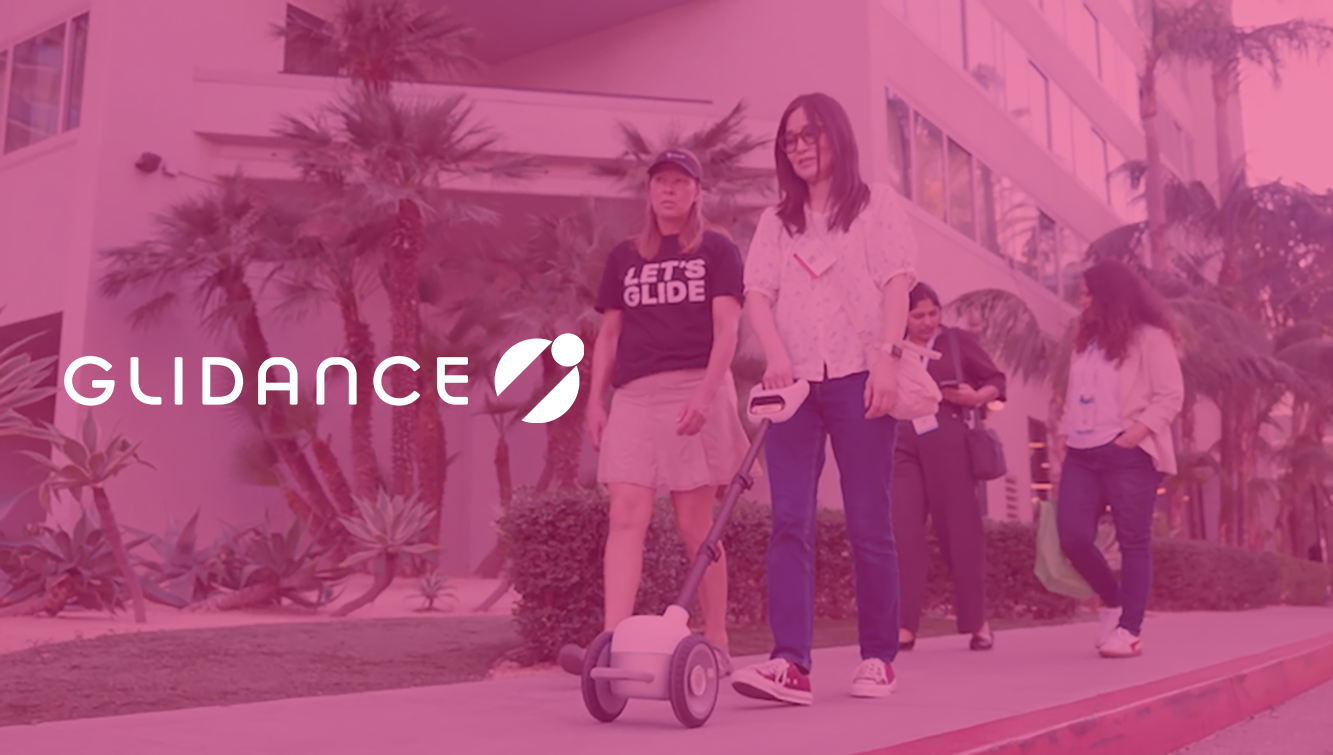
Glide is an intelligent guide from Glidance and a third primary mobility aid, with two all-terrain wheels on the ground and an adjustable telescoping handle that you hold with one hand in front of you. You start walking, set the pace, and Glide steers and brakes for you. It guides you around obstacles, detects drop-offs and overhead objects, and helps you find doors, crosswalks, escalators, and more.
It runs on Agentic Wayfinding™ technology, which was designed to work without HD maps, fixed infrastructure, or prior knowledge of the environment. You can read more on the technology page.
People sometimes call Glide a smart cane, but it works very differently from a cane. A smart cane adds sensors to a cane and alerts you, while Glide physically guides you by steering and braking. You can also ask Glide to describe your surroundings, and it can physically guide you to objects and targets within its line of sight.
At an intersection, Glide announces the crossing ahead and stops before reaching the crossing. Glide does not interpret traffic signals, so you decide when to cross, and once you start across, it keeps you from veering.
Cane and guide dog users have clear advantages in some places. Glide detects stairs, up and down, and brakes before you reach them, but you carry it by the handle to climb or descend, and it weighs about 9 pounds. It is water and weather resistant to an IP54 rating, but not fully waterproof (you shouldn’t submerge it in a pool, for example), and its performance in snow and ice is being optimized.
Glide is not weight-bearing and cannot be used with a support cane, walker, rollator, or wheelchair. It is not recommended at this moment for children under 13.
Casey Mathews, a Founding Glider who also uses a cane, wrote that his cane investigates edges and recovers a lost position better, while Glide handles continuous travel better, so he sees them doing different work. His full review of Glide and his cane covers where each one shines.
Cost, Training, and Funding Compared
Costs and time commitments differ widely, so it helps to see them side by side. The figures below come from each organization's own published information as of November 2026.
Glide is not currently reimbursable by insurance companies in the US, according to the Glide FAQ. Vocational rehabilitation (VR) agencies and state assistive technology programs are paths some people explore. Neither is confirmed to cover Glide, so ask the program directly and get any approval in writing.
Orders are currently closed while Glidance serves its preorder customers. You can join the waitlist to hear when orders reopen.
How to Choose a Primary Mobility Tool
There’s no single best tool. The long cane, a guide dog, and newer devices like Glide do different jobs, and the right fit depends on where you travel, how you like to travel, and what you can sustain over years. Many travelers use more than one, and most guide dog programs expect solid cane and orientation skills before placing a dog.
A Certified Orientation and Mobility Specialist (COMS) can assess your travel and help you try options. These questions can guide that conversation:
- Where do you travel, and how often? Busy sidewalks, transit, rural roads without sidewalks, trails, stairs, snow, and indoor spaces each favor different tools. Guide dogs need regular work to keep their skills sharp.
- What information do you want from your surroundings? A long cane lets you feel surface changes, curbs, and drop-offs directly, but it won’t detect obstacles above waist height. A guide dog steers you around obstacles, including overhead ones, but you’ll feel less of the ground. Glide also steers around obstacles as you push it. With any tool, you’re still responsible for orientation: knowing where you are and where you’re going.
- Can you care for a dog every day, for years? This includes feeding, relieving, grooming, vet care, and keeping the dog working in crowds and on transit. If anyone in your home has allergies, ask each school about breeds, since policies vary.
- What’s your timeline? Guide dog programs have eligibility requirements, waitlists, and usually several weeks of training, often residential. A cane is available right away. Glidance is currently developing its training program.
- What will it cost now and over time? Canes are inexpensive and often free through state vocational rehabilitation agencies or the NFB’s free cane program. Many guide dog schools place dogs at no cost to the handler, but ongoing care isn’t free. Glide’s preorder units sold out at the $1,499 preorder price, and final retail pricing has not been announced yet. Check what vocational rehabilitation, the VA, or other programs will fund.
- Do you have balance issues or hearing loss, or use a support cane, walker, or wheelchair? These affect every option. Glidance states that Glide can’t be used with these aids. Some guide dog schools work with handlers who use other mobility aids, and cane techniques can be adapted. Talk these through with a COMS.
Frequently Asked Questions
What harness do guide dogs use?
Guide dogs work in a guide dog harness made of a leather body that fits the dog's torso and a firm U-shaped handle that you hold.
At Guide Dogs for the Blind the handle is removable and comes in a straight or slightly rotated style, and handle type can affect your following position, so an instructor helps you choose. Guide Dogs for the Blind and The Seeing Eye keep ownership of the harness and ask for it back when the dog retires.
What is the difference between a guide dog and a service dog?
A guide dog is a type of service dog. The ADA defines a service animal as a dog individually trained to do work or perform tasks for a person with a disability, and guiding a person who is blind is one example. Dogs that provide only comfort or emotional support do not qualify.
Leader Dogs notes that its guide dogs are not trained to retrieve items, open doors, or alert to phones, which are tasks other assistance dogs may learn.
Can any breed of dog be a guide dog?
In practice, schools use a small group of breeds. Guiding Eyes reports that its pups are about 90 percent Labrador retrievers and 10 percent German shepherds.
The Seeing Eye breeds German shepherds, Labrador retrievers, golden retrievers, and Lab-golden crosses, and Leader Dogs uses Labradors, goldens, and crosses of those breeds. The school matches you with a dog, so ask each school how it makes that match.
What are the ongoing costs of owning a guide dog compared to other mobility aids?
Leader Dogs estimates about $1,500 a year for food, vaccinations, medications, and veterinary visits. Guiding Eyes estimates $80 to $100 a month for food and supplies and provides a $600 yearly stipend for basic veterinary care.
A white cane has little ongoing cost, and the NFB lets you request a replacement every six months. For Glide, preorder units sold out at the $1,499 preorder price, and final retail pricing has not been announced yet.
What mobility aid options are available if you can't have a dog?
The white cane, including smart canes, and Glide are the main options. A cane costs little and needs no charging, and a smart cane adds sensor alerts.
Glide steers and brakes for you, with limits: it is not weight-bearing, cannot be used with a support cane, walker, rollator, or wheelchair, and is not recommended for children under 13. An O&M specialist can help you test what fits.
Choose the Tool That Fits Your Routes
The guide dog vs white cane question has more than one good answer, and Glide adds a third. A cane offers low cost, simplicity, and direct feedback from the ground. A guide dog offers a trained partnership with strong school support. Glide offers a new way of physically navigating the world, powered by advanced robotics and AI.
Start with your routes, talk with an O&M specialist, and try what you can. The decision is yours, and it can change as your life does. If Glide sounds like a fit, you can join the waitlist while orders are closed.
Post Author
Jonathan Kalan
Jonathan Kalan is Head of Marketing & Brand at Glidance. For the past decade, his work has been focused on building, launching and communicating category-defining products, brands and experiences.
Ready to Glide?
Sign up below to receive more information about Glide, get in touch with our team, and secure your spot on our waitlist for when we re-open orders!


