

Mobility Aids for Blind and Low Vision People: A Complete Guide to Your Options
November 20, 2026
People who are blind or have low vision travel in many ways. Some work with a human guide, some use a white cane, some partner with a guide dog, and a growing number are trying newer tools. Choosing among these mobility aids is a personal decision. No one tool is better than another, and an orientation and mobility (O&M) specialist or other vision rehabilitation professional can help each person decide based on their situation and needs. This guide explains what each option brings, how training and funding work in the US, and how people weigh their choices.
What Is a Primary Mobility Aid?
A primary mobility aid is the tool that blind and low vision individuals rely on every day to travel independently. It physically helps a person move through the world. The main categories are a human guide, a white cane (including smart canes), a guide dog, and Glide, from Glidance.
Supplemental assistive technology tools or mobility and navigation aids are different. A navigation app, an AI vision app or a pair of smart glasses can describe a place, read a sign or call a volunteer, and many people use them daily alongside a primary aid. They add useful information, but do not physically guide a traveler around an obstacle.
With any tool, the traveler stays responsible for orientation, which means knowing where they are and where they are going.
Mobility Aids for Visually Impaired, Blind and Low Vision Travelers: The Main Options
This table shows what each primary option brings. Nothing in it is ranked.
An intelligent, AI-powered guide that steers and brakes for the traveler, can describe a scene, and guide to line-of-sight targets.
Want physical guidance and are comfortable with technology, but either don’t qualify for, cannot care for, or do not prefer a guide dog
The Human Guide
Many people begin with a human guide, often called sighted assistance. The traveler lightly holds the guide's arm just above the elbow and walks half a step behind. It needs no equipment and carries the warmth of traveling with someone you know. A certified O&M specialist can teach both people the technique.
How a White Cane Works
The white cane is the baseline primary mobility aid that most people learn first, and it deserves its reputation. It is the most accessible option: affordable, extremely portable, free of charging and maintenance, and recognized by drivers and pedestrians around the world. The traveler sweeps the cane in front of them and reads the ground through the tip, which tells them about curbs, steps, surfaces and objects at ground level. Millions of people travel with confidence this way every day.
Canes come in a few types. A long cane is the full-length mobility cane used for travel. An identification cane is lighter and mainly signals to others that the user is blind or has low vision. A support cane gives physical balance support and is a different tool from a mobility cane.
The National Federation of the Blind (NFB) Free White Cane Program gives a free straight fiberglass cane to blind people in the US who request one, as often as every six months.
Smart Canes
Smart canes are primary mobility aids in the cane category. A smart cane is a cane with additional sensors and intelligent features that alert the user to what is ahead or help them navigate, and it is used with the same technique as any other cane. They are a relatively new addition to the market. WeWalk is one example: its website describes a smart cane built with and for the blind and partially sighted community, with upper-body obstacle detection, voice navigation through a companion phone app, and the option to use it as a lightweight classic cane when the smart features are off. WeWalk lists availability in the US and Canada.
How a Guide Dog Works
A guide dog is a trained partner for an active, busy lifestyle. The dog guides its handler around obstacles, stops at curbs and steps, and works with the handler through a lifetime of routes. Accredited schools invest heavily in this partnership. Guiding Eyes for the Blind, for example, states that it provides all of its services free of charge, including follow-up support after a graduate goes home, and relies on donations to do so.
A guide dog often suits individuals who enjoy working with an animal and are ready to care for one every day. The International Guide Dog Federation keeps a directory of its member guide dog schools worldwide.
How Glide Works
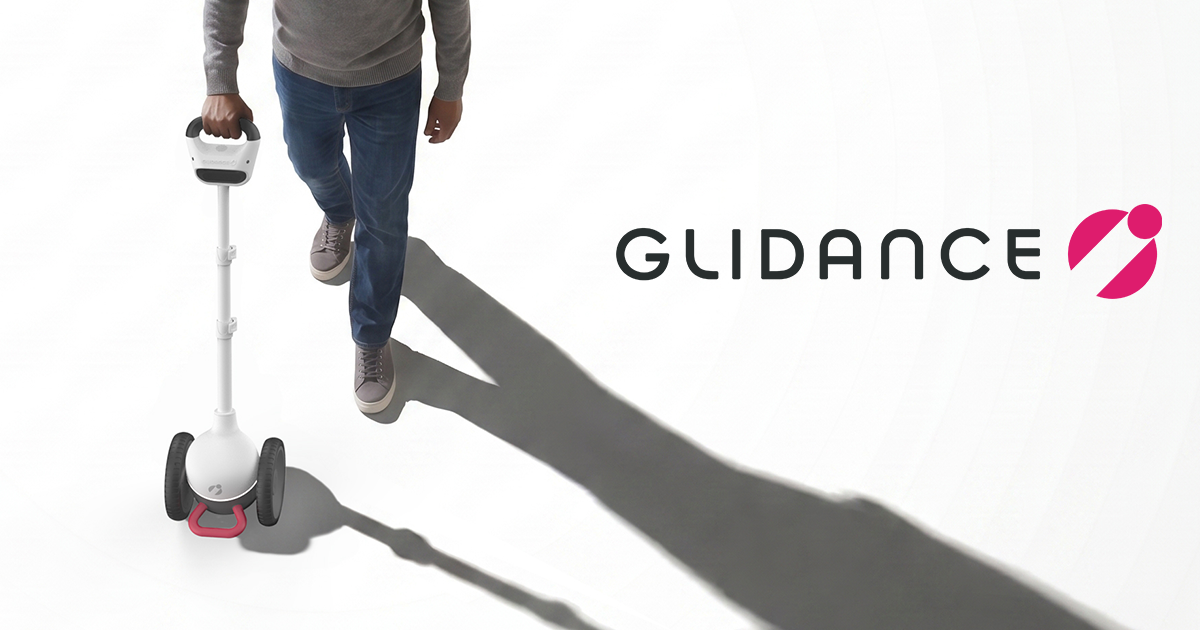
Glide is a third primary mobility aid, alongside the white cane and the guide dog. It is a new way of physically navigating the world, powered by advanced robotics and AI. Glide has two all-terrain wheels on the ground, an adjustable telescoping handle that the traveler holds in front of them with one hand, and cameras and sensors that read the environment in real time. The traveler starts walking and sets the pace, and Glide steers and brakes for them. It guides around obstacles, including overhead ones, stops at drop-offs and stairs, and helps find doors and elevators. On request, it describes the surroundings and guides to objects and targets within its line of sight. It runs on Glidance's patent-pending Agentic Wayfinding™ technology, which is designed to work without HD maps, fixed infrastructure or prior knowledge of the environment. The Glide product page lists the full specifications.
People sometimes call Glide a smart cane, but it works very differently from a cane. A smart cane adds sensors to a cane and alerts the user, while Glide physically guides the traveler by steering and braking.
At a street crossing, Glide announces the approaching road, stops before the down-curb and helps keep the traveler walking across without veering. It detects stairs up and down and brakes before them, and the traveler can carry it up or down by the handle (it weighs about 9 lbs), the stem, or by rolling it behind or in front of them. Glide has clear limits. It is not weight-bearing and cannot be used with a support cane, walker, rollator or wheelchair. It is recommended for ages 13 and up, is water resistant but not waterproof, and is not yet optimized for snow and ice. Glide works alongside O&M training. It is available in the US, Canada and the UK.
Supplemental Tools That Add Information
Supplemental tools are not primary mobility aids, yet many people find them very useful next to one. They fall into a few groups.
Navigation Apps
BlindSquare is an accessible GPS app for blind, deafblind and partially sighted users that speaks the names of nearby places, street crossings and landmarks. Lazarillo is a free app with audio alerts and turn-by-turn guidance indoors and outdoors. Microsoft Soundscape, a free iPhone app that Microsoft Research released in 2018, described streets and landmarks in 3D audio, and Amos Miller, Glidance's founder and CEO, led the project. Microsoft retired it in 2023 and made its code open source, and the community carries it on in apps such as VoiceVista, a free iPhone app built on that code.
Human Visual Interpreting Services
Be My Eyes is a free app that connects a blind or low vision person by live video with a sighted volunteer, a quick way to read a label or find a dropped item, and sometimes a chance to make a new friend. The app also offers Be My AI, which is separate from the volunteer service. Aira connects users with professional visual interpreters through its Explorer service, and it is free at participating Access Partner locations.
AI Vision Apps and Glasses
Seeing AI is a free Microsoft app for iPhone and Android that narrates the surroundings, reads text, describes photos and identifies products. Envision Glasses are AI-powered smartglasses that read text, describe scenes, find objects and recognize people you teach them to know. Wearable obstacle-detection devices also exist, and the maker's own information shows what each one detects.
Low Vision Supports
Many people with low vision use their remaining vision as part of how they travel, and the right supports can make that easier. A handheld telescope, called a monocular, helps read street signs and bus numbers from a distance. Bioptic glasses have a small telescope mounted in the lens. Good lighting, glare control and high-contrast markings, such as bright tape on stair edges, also help. A low vision specialist, who is an eye doctor with extra training in vision rehabilitation, can assess these tools. Many people with low vision also use a primary aid alongside their remaining vision.
O&M Training as the Foundation
Orientation and mobility training teaches people to travel safely and independently: building a mental map, crossing streets, using public transit and handling unfamiliar places. It is the foundation for every primary mobility aid, including a cane, a guide dog and Glide. A certified O&M specialist or other vision rehabilitation professional can assess needs, teach technique and help someone try different aids. In the US, the Academy for Certification of Vision Rehabilitation and Education Professionals (ACVREP) maintains a directory of certified professionals, including Certified Orientation and Mobility Specialists.
Paying for Mobility Aids in the US
These funding routes apply in the US. Rules differ in Canada, the UK and elsewhere, so readers there should check with their national agencies.
- Free canes. The NFB program above provides a cane at no cost.
- Guide dog schools. Many accredited schools provide the dog and training free of charge. The International Guide Dog Federation directory above lists member schools.
- State vocational rehabilitation (VR) agencies. VR agencies help eligible people prepare for, find or keep work, and may fund training or technology that supports employment. The National Council of State Agencies for the Blind keeps a list of state agencies.
- State assistive technology programs. Each state runs a program that offers device demonstrations and loans. The AT3 Center has a directory of state assistive technology programs.
- U.S. Veterans. The Department of Veterans Affairs (VA) Blind Rehabilitation Service supports eligible Veterans with vision loss. A Visual Impairment Services Team (VIST) coordinator is usually the entry point, and the VA lists its VIST coordinators and its 13 Blind Rehabilitation Centers. Eligibility generally starts with being legally blind, which means 20/200 vision or worse in the better eye with correction, or a visual field of 20 degrees or less.
For Glide, preorder units sold out at the $1,499 preorder price, and final retail pricing has not been announced yet. The waitlist is open. Glide is not currently reimbursable by insurance in the US. A VR agency, state assistive technology program or VIST coordinator may cover Glide, so it is worth asking. The Glidance FAQ has current details.
How to Choose Among Mobility Aids
Many people choose what fits their life now and revisit it as things change. Useful questions to ask include:
- Where do I travel most: city streets, campus, rural roads, indoor spaces or all of these?
- How much time and daily care am I ready to give, and do I want to care for an animal?
- How comfortable am I with charging, apps and updates?
- What support can I get for training and funding?
- Which aid helps me feel confident on the routes I walk most?
Trying options hands-on, with a certified O&M specialist or other vision rehabilitation professional, tends to answer these questions better than reading about them.
Switching From a White Cane to Another Aid
Changing aids is common, and the cane often stays in the picture. People who move to a guide dog or Glide often keep a cane for situations where it suits them. An O&M specialist can help plan the transition, starting with familiar routes, and each aid has its own learning curve. Orientation skills built with a cane carry over.
Frequently Asked Questions
What types of mobility aids are available for people who are blind or have low vision?
Primary mobility aids include a human guide, a white cane (including smart canes), a guide dog and Glide. Supplemental tools and devices include navigation apps such as BlindSquare and Lazarillo, visual interpreting services such as Be My Eyes and Aira, AI apps such as Seeing AI, and smart glasses such as Envision Glasses. Low vision supports include telescopes, bioptic glasses and better lighting.
How do people choose between a white cane, guide dog, and Glide?
People choose based on their environments, lifestyle, comfort with technology, training and funding, and no option is ranked above another. A cane often suits individuals who want a simple, portable aid. A guide dog often suits those who enjoy working with an animal. Glide often suits those who want physical guidance and are comfortable with technology. A certified O&M specialist can arrange trials so the choice rests on experience.
Can people get financial help to cover the cost of mobility aids?
Yes, in several ways in the US. The NFB gives free white canes, many guide dog schools provide dogs and training free of charge, and state VR agencies, state assistive technology programs and the VA may help eligible people with other tools. Coverage varies, so ask first and get approvals in writing. Rules differ in other countries.
What is the difference between a primary mobility aid and a supplemental assistive device?
A primary mobility aid is the tool a person relies on every day to physically travel independently, such as a cane, a guide dog or Glide. A supplemental device, such as a navigation app or AI vision app, adds information about the surroundings without physically guiding the traveler.
Do people need O&M training before using a new mobility aid?
Training is strongly recommended, but it is not a formal requirement for every product. A certified O&M specialist can teach orientation, street crossing and safe technique that apply to any aid, and guide dog schools include their own handler training. Glide works alongside or builds off of foundational O&M training. Contact a specialist through the ACVREP directory or a state agency.
What should people consider when switching from a white cane to a different mobility aid?
Consider the routes you travel most, the training offered, the daily care involved and whether you want to keep a cane for some situations. Work with an O&M specialist, practice on familiar routes first, and allow time to build rhythm with the new aid.
Choosing With Confidence
Mobility aids for blind and low vision people cover a wide range, from a human guide and a white cane to a guide dog, a smart cane, Glide and supportive apps. Each helps people travel with confidence. The right choice fits a person's routes, preferences and support network, ideally with a certified O&M specialist or other vision rehabilitation professional alongside. Anyone curious about Glide can join the Glidance waitlist and follow updates there.
Post Author
Jonathan Kalan
Jonathan Kalan is Head of Marketing & Brand at Glidance. For the past decade, his work has been focused on building, launching and communicating category-defining products, brands and experiences.
Ready to Glide?
Sign up below to receive more information about Glide, get in touch with our team, and secure your spot on our waitlist for when we re-open orders!


